Bo Wang, CFA
Ze Liang
January 2024
As a global issue closely related to ecological and environmental security and the common interests of mankind, in recent years, the impact of climate change has received attention from all sectors of society, and its risk transmission to the financial system has also alerted regulators and investors alike. Climate change may lead to structural changes in the economic and financial systems through different channels. The risks posed by climate change to financial institutions and their managed investment portfolios cannot be overlooked. Against this backdrop, our recent research first looked at the gap between relevant regulations and climate risk reporting practices. Then we focused on measures to quantify climate risks for listed equity portfolios, which is a foundational step to manage climate risk at a portfolio level for asset managers.
From the policy perspective, leading regulators globally have tightened their requirements for climate risk analyses and management, urging financial institutions to continue to promote the integration of climate risk into their risk management and investment decision-making processes. We found that for climate risk management, regulatory policies targeting climate risk for financial institutions have widely been issued, but those focusing on asset managers are still in the minority. In terms of disclosure, national supervisory authorities have generally adopted the TCFD (Task Force on Climate-related Financial Disclosures) Working Group's guidelines for financial institutions, and they specify the types of metrics and scenario analysis methodologies that institutions are required to disclose. Overall, it is expected that climate risk disclosure for asset managers is expected to become more comprehensive over time.
In response to this trend, global asset managers have gradually carried out climate-related risk assessment at the company and portfolio levels. However, in terms of metrics to measure climate risk, most asset managers adopted impact indicators such as portfolio carbon intensity, whereas assessments of the financial impact of climate risks on portfolios are still relatively limited, contrary to common regulatory rationales around financial impact of climate risks.
To bridge the gap between regulatory intentions and climate risk management in the asset management industry, we selected the climate value-at-risk (CVaR) data by various vendors, which is widely used in the industry to gauge the financial impact of climate risks. Specifically, we analyzed the climate risk of the CSI 300 portfolio with the CVaR data from local and international data providers (GSG, MioTech, MSCI, SynTao Green Finance, and YoujiVest).
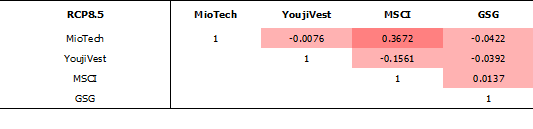
Through the correlation analysis of the vendors' CVaR data, we found that for transition risk, the data from each data provider showed some degree of correlation, however, when broken down to some scenarios, the discrepancies in their data become more pronounced. In terms of physical risks, the data from various data vendors have not yet shown a strong correlation with each other, and the differences are more striking.
Figure 1: Correlation of transition CVaR under different scenarios
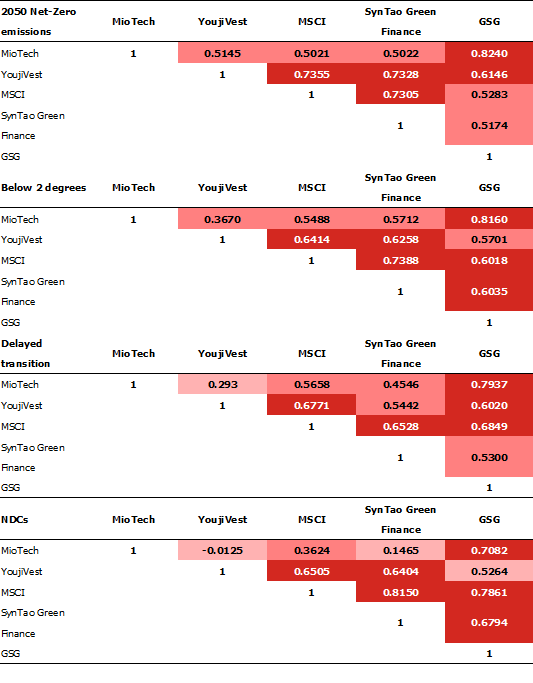
Figure 2: Correlation of physical CVaR under the RCP8.5 scenario
Meanwhile, we utilized the data on physical risks and transition risks of companies in the CSI 300 Index to conduct a cross-sectional analysis of their financial indicators in the third quarter of 2023 (aligned with the date of the CVaR data), including asset impairment losses, capital expenditures (Capex), free cash flow, revenue, revenue growth rate, return on equity (ROE), operating costs, and debt financing costs (only cross-sectional analysis is limited by the availability of CVaR data). We found that there were not many instances where the climate risk data showed a significant correlation with the chosen financial indicators of the companies. However, this conclusion offers a new perspective for the measurement of climate risks in listed companies, suggesting that the correlation between CVaR and financial indicators is not strong on the cross-sectional level. This can help avoid or reduce the problem of multicollinearity that may arise from introducing these factors into investment models. It also indirectly validates the possibility of portfolio, where the climate risk of the portfolio is reduced while controlling for deviations from the benchmark financial performance.
The results of these correlation analyses suggest that there may be significant differences in the underlying methodologies used by different international and local data providers to construct CVaR (especially physical CVaR) models, which may result from inconsistencies in the underlying indicators used to quantify the physical risk and the transition risk. In our future research, we will investigate the underlying methodologies and sources of divergence in the results of different data providers.
Figure 3: Relative climate risk exposure of the CSI 300 portfolio (end of Q3 2023)
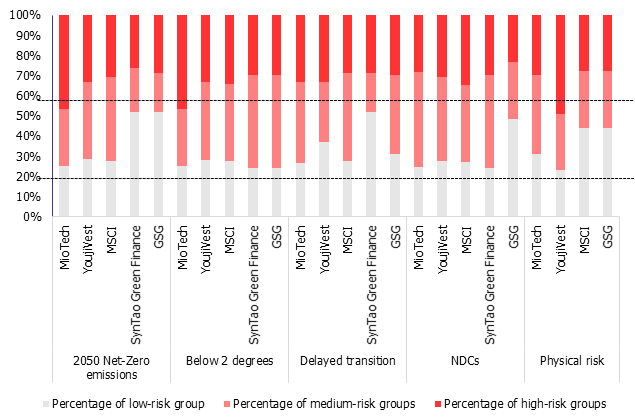
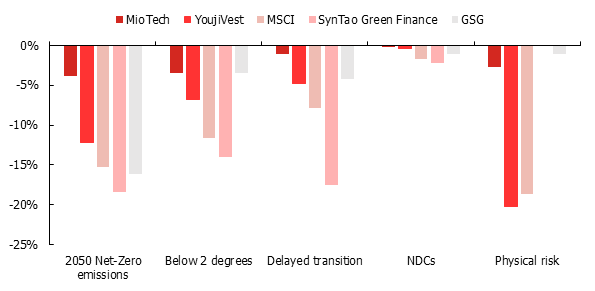
Figure 4: Absolute climate risk exposure of the CSI 300 portfolio (end of Q3 2023)
We believe that continuous improvement of climate risk data will be needed to accelerate the industry's efforts to enhance the transparency of climate risk in the financial industry. This will, in turn, hasten the development of relatively unified methodologies and indicators for climate risk analysis and management both domestically and globally. It will better connect regulatory requirements with industry practices and integrate the results of climate risk assessments into overall risk management.
 Chinese 中文